

The charging time of forklift battery is one of the core factors in the efficiency of logistics operations. A single improper charge can result in a 20% spike in costs or even a loss of battery life. In this article, we’ll take a closer look at the key variables that affect charging time, helping you balance efficiency with battery health.
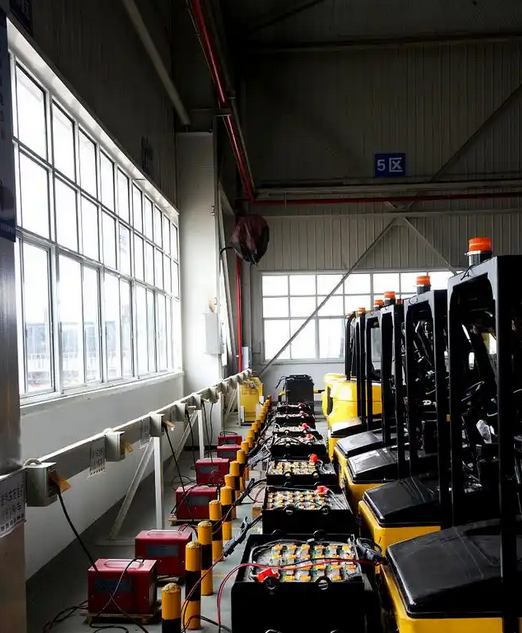
Forklift Battery Charging Time Formula
Charging time (hours) = (Battery capacity Ah × Depth of discharge) ÷ (Charger power A × Efficiency coefficient 0.8)
Example: 800Ah lead-acid battery discharged to 50%, using a 100A smart charger
(800 × 0.5)/(100 × 0.8) = 5 hours
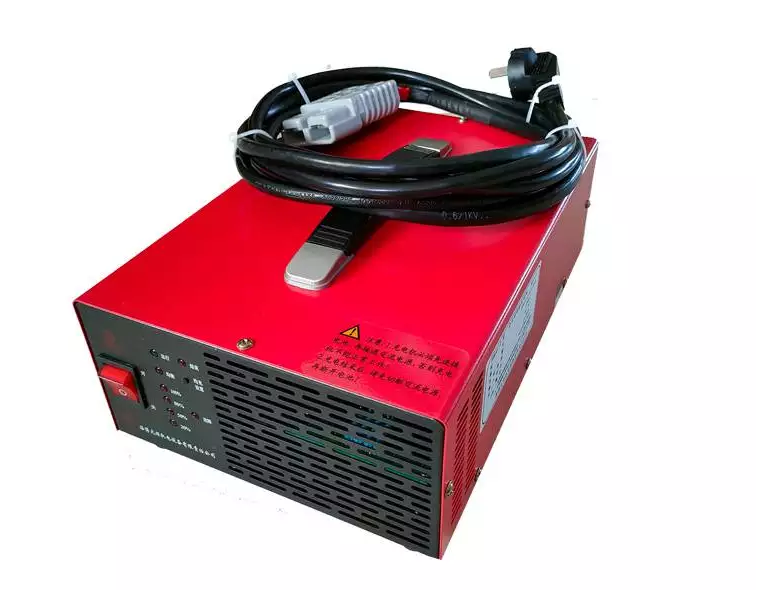
Three-stage charging method for lead-acid batteries
Constant current phase: 20% charge fast (0.2C rate)
During this phase, the charger rapidly charges the battery at a constant high current.
The purpose is to quickly restore most of the battery’s charge in a short period of time.
This stage ends when the battery voltage reaches a preset conversion voltage (usually close to but slightly below the full charge voltage of the battery).
Constant voltage phase: Charge to 95% to prevent overvoltage
During this phase, the charger maintains the voltage at a constant level while gradually reducing the charging current.
The battery continues to receive a charge under constant voltage conditions until the current decreases below a set value (called the trickle charge threshold).
This process helps ensure that the battery is fully charged and reduces the risk of overcharging.
Float phase: maintenance of charge balance
During this stage, the charger maintains the battery in a state of charge with a very low current.
It is mainly used to compensate for the battery’s loss of power due to self-discharge and to keep the battery in a fully charged state.
This stage is especially important for batteries that have been stored for a long period of time to prevent them from being damaged by over-discharge.
FAQ
Q: What is the difference between charging 24V/48V/80V systems?
A: Voltage level affects charger selection, 48V system is recommended to match 60A or above charger
Q: When should I replace the battery?
A: When the capacity is reduced to 80% of the nominal value, or the charging time is abnormally extended by 30%.